
Home/ Dust Collection/ Cyclonic System

Dust Collection

Cyclonic
System

Centrifugal pre-separation in a cone-shaped chamber — no filter bags, no moving internal parts. Ideal upstream of baghouses for bulk dust removal.
No Filter Bags No Moving Parts Pre-Baghouse Duty
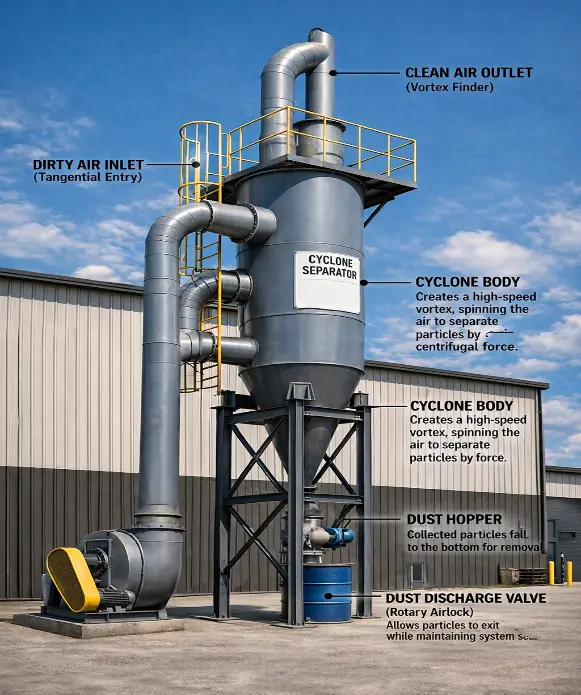
Cyclonic dust collection system — annotated field installation with inlet, separator body, clean air outlet and dust discharge

What is it

What is a Cyclonic System?

A cyclonic dust collector is a device that separates dust or particles from an air stream by spinning the air rapidly inside a cone-shaped chamber.

  • No filter bags needed
  • No moving internal parts

How Cyclonic Systems Work

Dust-laden air enters tangentially — this creates a spiraling motion inside the cyclone. The spinning air creates strong centrifugal force, and heavier dust particles are thrown outward to the wall. Once they hit the wall, particles lose speed, and gravity pulls them down into the hopper.

The air forms an inner upward spiral, and clean(er) air exits through the top outlet. Cyclone separators are used before baghouses to remove bulk dust.
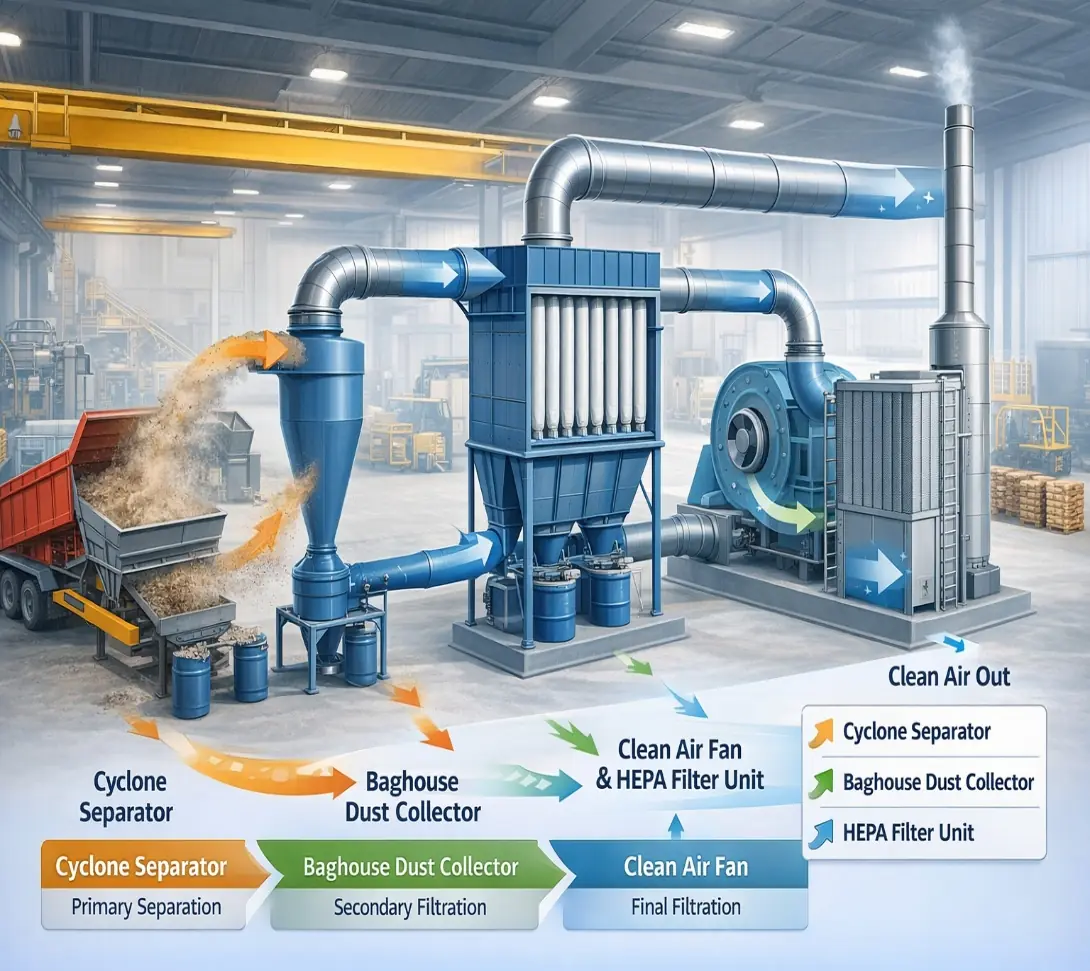
Three-stage dust collection process — cyclone separator, baghouse and HEPA filter unit
System process flow
0Filter Bags Required
LowPressure Drop
BulkPre-Separation Duty
6+Industries Served

Technical illustrations

Cyclonic System Reference Diagrams

Reference diagrams from GPC client documentation.

Three-stage dust collection — cyclone separator primary separation, baghouse secondary filtration and HEPA final filtration
Three-stage process — cyclone, baghouse and HEPA filter unit
Cyclonic dust collection field installation — dirty air inlet, cyclone body, clean air outlet, dust hopper and rotary discharge valve
Field installation — inlet, separator body, outlet and dust discharge

Model selection

Cyclone Dust Collector Selection Guide

GPC cyclone models — airflow capacity, inlet and outlet sizes, cyclone diameter and overall dimensions across the range.
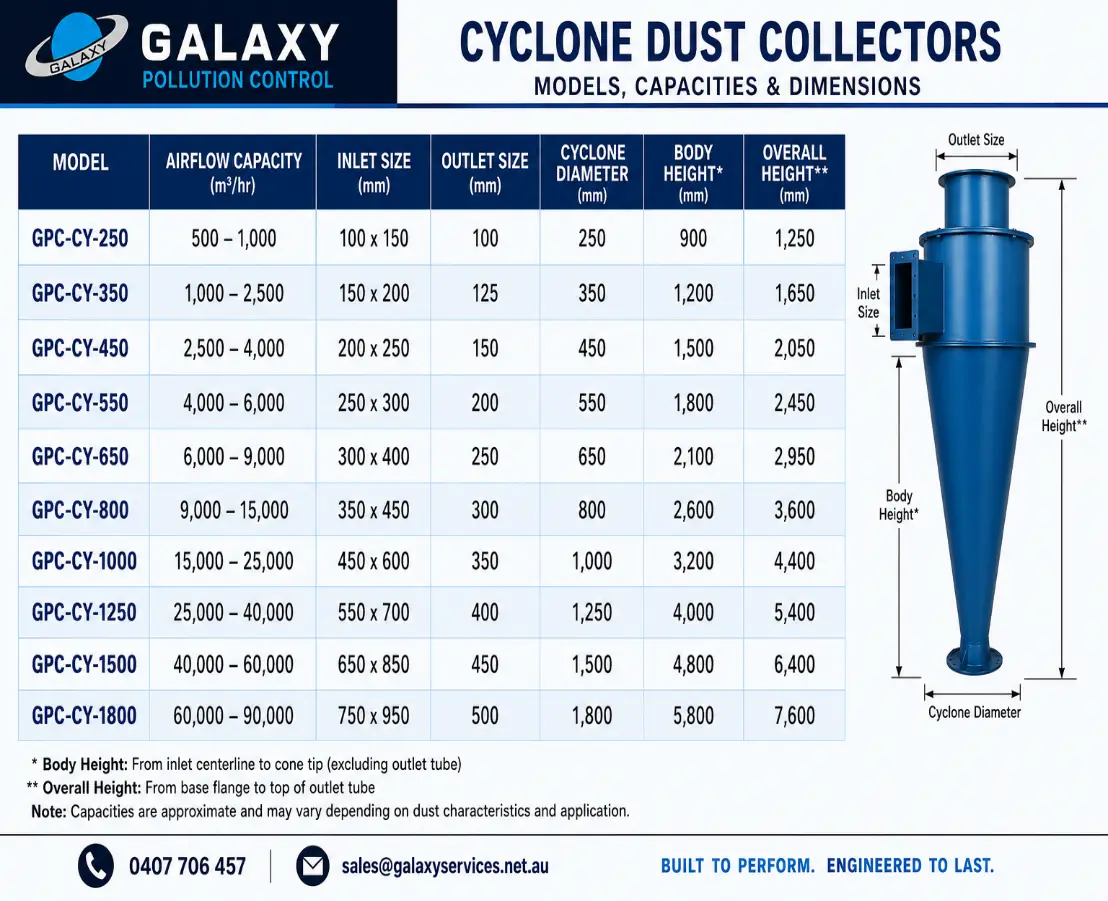
GPC Cyclone Dust Collectors — models, capacities and dimensions from GPC-CY-250 through GPC-CY-1800

Capacities are approximate and vary by dust characteristics and application. Contact us for precise sizing — 1300 131 944 or request a quote.

Operating Principle

How Cyclonic Separation Works

Centrifugal force separates coarse particles from the gas stream — no fabric media, no compressed air, and minimal maintenance for reliable pre-cleaning duty.

01
Dust-laden air enters the cyclone inlet
Contaminated gas is introduced tangentially into the cyclone body, establishing a high-velocity rotational flow pattern within the chamber.
02
Air spins rapidly in the cone chamber
The tangential entry and conical geometry maintain a stable vortex — spinning the entire gas stream at high angular velocity.
03
Centrifugal force throws particles outward
Heavier dust and particles migrate to the cyclone wall under centrifugal acceleration — far exceeding gravitational settling rates.
04
Particles slide down the wall to the hopper
Collected material spirals downward along the interior surface and discharges into the collection hopper for removal.
05
Cleaner air exits through the top outlet
The inner vortex reverses direction and exits via the central outlet tube — significantly reduced in coarse particulate loading.
06
Downstream baghouse receives protected airflow
Pre-cleaned gas flows to pulse jet, reverse air or shaker collectors — extending filter life and reducing maintenance on the primary collector.

Applications

Industries Served

Cyclonic separators excel where coarse, abrasive or high-loading dust must be removed before fine filtration — especially in mining, cement and bulk material handling.

Mining & Minerals
Pre-separation of coarse ore and rock dust before baghouse filtration.
Cement & Lime
Bulk clinker and kiln dust removal upstream of fabric filters.
Wood & Sawmills
Coarse sawdust and chip separation protecting downstream collectors.
Grain & Feed
High-loading grain dust pre-cleaning at transfer and milling points.
Boilers & Power
Ash and coarse particulate pre-separation on exhaust gas streams.
Metal Processing
Heavy abrasive dust removal before fine baghouse collection.
Bulk Handling
Transfer point dust knock-out for pneumatic and mechanical conveying.
Recycling Plants
Mixed coarse fraction separation before secondary filtration stages.
System Components
Complete cyclonic separation packages from GPC include:
  • Cyclone body & cone section
  • Tangential inlet & vortex finder
  • Collection hopper & discharge
  • Inlet / outlet duct transitions
  • Multi-cyclone arrangements
  • Fan & ductwork integration
  • Downstream baghouse interface
Key Benefits
Why cyclonic pre-separation protects your dust collection system:
  • No filter bags — lower media and maintenance cost
  • Robust design with no internal moving parts
  • Handles abrasive and high-temperature dust
  • Extends baghouse filter life significantly
  • Low operating cost and pressure drop penalty
  • Scalable from single to multi-cyclone banks
  • EPA & Australian compliance ready

Maintenance & Support

Simple inspection routines keep cyclonic separators performing at peak pre-separation efficiency.

Inlet & cone wear inspection
Hopper & discharge audit
Airflow & pressure drop check
Duct connection integrity
Downstream collector review
Emergency breakdown support
Why Galaxy Services?

Need cyclonic pre-separation
for your dust system?

We size cyclones for your airflow, dust loading, particle size distribution and downstream collector — delivering reliable pre-separation that protects filter media and reduces total cost of ownership. Talk to our engineers today.

Book a System Assessment
Site evaluation, cyclone sizing and system integration review.
Contact Us